Register Now


About The Programme
What Is The Aim of This Programme?
- Lung cancer is the most common cancer in Hong Kong, and its mortality rate is the highest among all cancers[1]
- Approximately 70% of lung cancer cases are diagnosed at stage III or IV[2], resulting in limited treatment outcomes and a low five-year survival rate (24.6% and 7.8% [3] respectively)
- Early detection at stage I offers a significantly higher 5-year survival rate of 72.4%[3], increasing the likelihood of complete resection and cure
- LDCT screening has proven effectiveness in early lung cancer detection internationally.[4] [5] [6], but there is a lack of local evidence on its clinical and cost-effectiveness[7]

Through your participation, we can collect locally relevant data on clinical effectiveness, cost-effectiveness, and feasibility in Hong Kong, thereby providing evidence-based recommendations for the future integration of lung cancer screening into the Hong Kong healthcare system.
Am I Eligible To Participate In This Programme?
You are eligible to participate in this study if you meet all of the following criteria:
- Aged between 50 and 79;
- having a smoking history of at least 20 pack-years*;
- Current smokers or former smokers who quit smoking within the past 10 years.
You are not eligible to participate in this program if you meet any of the following conditions:
- Non-Chinese;
- Mentally incompetent to provide informed consent;
- Prior diagnosis of lung cancer or have detected lung nodules;
- History of other cancers within the past five years, or currently under treatment;
- Have undergone a CT scan of the thorax in the previous 12 months;
- Either unwilling to undergo a chest LDCT scan, or you have a condition that prevents you from having a CT scan (for example, pregnancy or inability to lie flat on the CT table)
* Pack-year is a measure of the amount of a person has smoked over a long period of time. It is calculated by multiplying the average number of packs of cigarettes (20 sticks) smoked per day by the number of years the person has smoked. For example, 20 pack-years is equivalent to smoking one pack of cigarettes a day for 20 years, or smoking half a pack of cigarettes a day for 40 years.
Pack-year Calculator:
The programme targets 15,000 high-risk ever-smokers from the general community of Hong Kong. Recruitment and follow-up efforts will be carried out in partnership with six NGOs (Christian Family Service Centre, Pok Oi Hospital, Hong Kong Sheng Kung Hui Welfare Council Limited, The Lok Sin Tong Benevolent Society, Kowloon, Tung Wah Group of Hospitals, and United Christian Nethersole Community Health Service), leveraging their smoking cessation programs and registered community networks. This group includes current smokers and former smokers who quit within the past 10 years, a population at elevated risk for lung cancer due to prolonged tobacco exposure.
What Will Happen To Me If I Take Part?
1. Registration and Baseline Questionnaire
You will undergo a simple eligibility assessment and complete a registration questionnaire, including:
- Personal data, demographic and epidemiological data
- Smoking history, alcohol consumption, and dietary habits
- Anthropometry (weight, height)
- Personal medical history (e.g. cancers and chronic obstructive pulmonary disease (COPD))
- Family history of lung cancer
- General health status (e.g. cardiovascular, pulmonary, renal, liver, metabolic, autoimmune and immune function-related diseases or treatments, and medication use)
- Health-related quality of life assessed using the EQ-5D tool
- General understanding, related attitudes and behaviors regarding low-dose computed tomography (CT) scans
2. Randomization
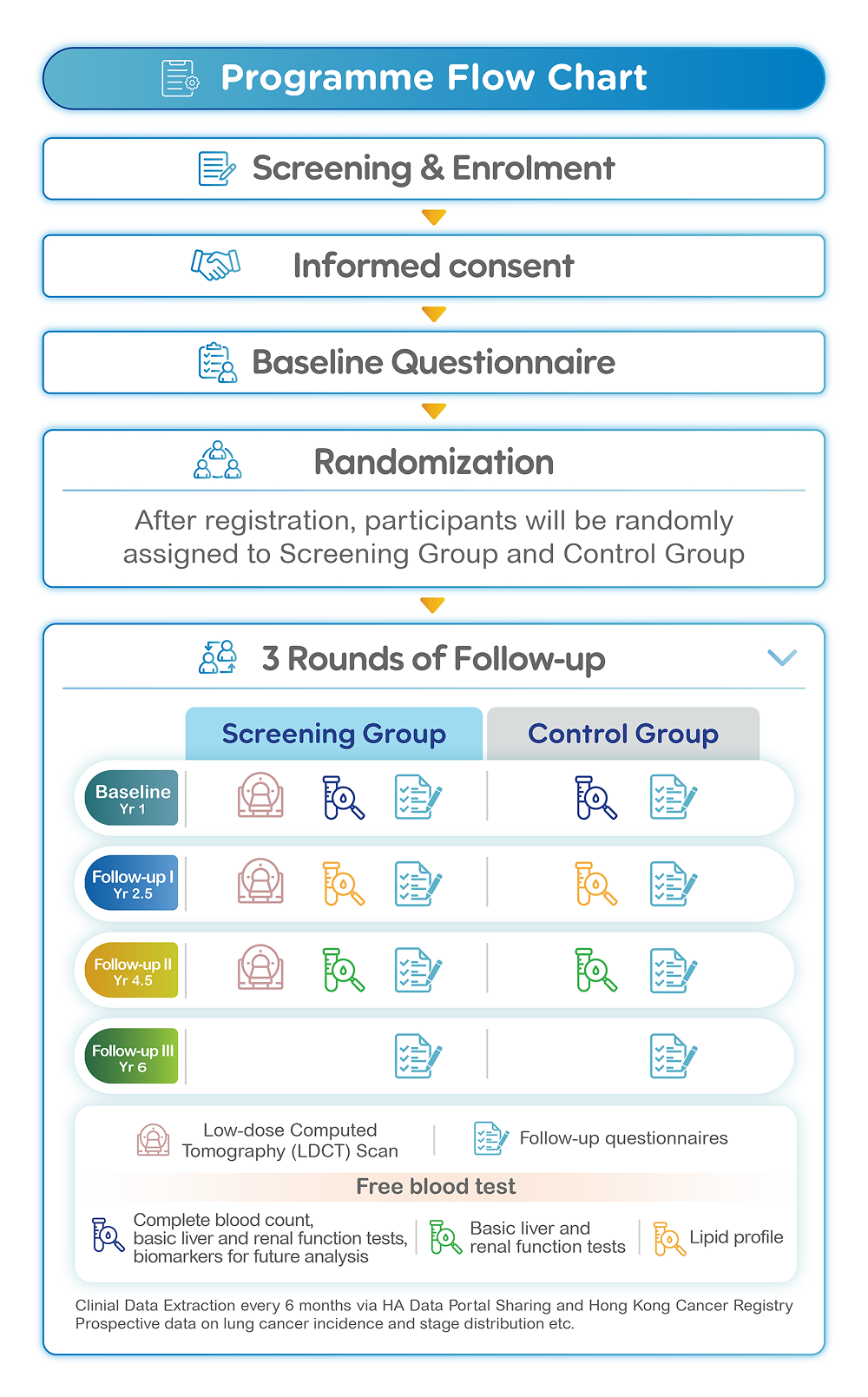
After registration, participants will be randomly assigned to two groups:
- Screening group (approximately 7,500 people):
Participants will be scheduled to undergo three low-dose computed tomography (CT) scans at:
1st time: Baseline: (T0, within three months of registration).
2nd time: 18 ± 3 months after baseline (T1)
3rd time: 42 ± 3 months after baseline (T2) - Control group (approximately 7,500 people):
Participants will not be scheduled to undergo low-dose computed tomography (CT) scans.
Participants in both groups will be invited to complete follow-up questionnaires at T1, T2, and T3. Additionally, free blood tests will be offered as an incentive to encourage continued participation, including complete blood count, lipid basic renal and liver function tests to monitor any changes in health status and to identify potential long-term trends or emerging health issues
3. Low-dose Computed Tomography (LDCT) Scan
You may be invited for LDCT scan for screening of lung cancer if you are randomized to the screening group of the study, over the 5-year follow-up period. A LDCT of the thorax takes very detailed pictures of the lungs and nodules as small as 1 mm can be seen. You will be asked to take a deep breath and hold it for 15 seconds during the scanning procedure. The procedure takes about 10-15 minutes.
4. Blood Test
Free blood tests including complete blood count, basic liver and kidney function, and lipid profile will be provided to all participants at T0, T1, and T2. Additionally, it will be used to analyse biomarkers—such as immune cells, proteins, and other substances—that may predict or be associated with the presence of lung cancer.
5. Programme Flowchart
Are There Any Disadvantages or Risks of Taking Part?
Low-dose computed tomography (LDCT) scans
Whether there are additional risks (e.g. cancer) associated with receiving low-dose computed tomography (LDCT) is not a major concern in lung screening program. The amount of radiation exposure with low dose CT scan in this study is ≤1.5 mSv[8] whereas the annual natural radiation exposure in Hong Kong is around 2 mSv[9] and the normal dose diagnostic CT Thorax is 5 - 8 mSv[10]. None of these radiation doses has been shown to be a significant cause for cancer development or any tissue damage. The finding of spots on your LDCT scan may lead to repeat imaging studies (LDCTs, PET-CT scan), biopsy or surgery. One of the purposes of this study is to find out if our nodule cancer risk prediction tool can minimize unnecessary testing.
Because a LDCT scan can pick up abnormalities as small as 1 mm, there is a 10% chance of having repeat LDCT scans for follow-up of abnormalities that turn out to be non-cancerous. Non-cancerous conditions such as infection or inflammation can also grow and look like a cancer on a LDCT scan. The chance of having an unnecessary biopsy or surgery is approximately 1.7% and 0.96%[11], respectively. The risk of a major complication after a biopsy or surgery is 0.1%[11]. The risk of death within 60 days after an invasive diagnostic procedure or surgery is about 0.035%. Also, for some individuals, a possible diagnosis of lung cancer may cause anxiety while waiting for test results. For these reasons, we are offering screening LDCT scan only to those at high risk of lung cancer instead of doing mass screening in the general population.
Blood Taking
The blood taking process may involve the following risks:
- Rubbing alcohol used to clean your skin before taking the blood sample may cause redness of your skin.
- Insertion of a needle into one of the veins in your arm for the blood tests may cause pain, bruising or rarely, an infection of your skin.
What Are The Benefits of Taking Part?
Although you are not guaranteed to gain any medical benefit directly from this programme, you can help to:
- Contributing to generating new medical and scientific knowledge
- Helping the investigator team to understand the feasibility and applicability of lung cancer screening among high-risk smokers in Hong Kong
- Guiding future evidence-based policy-making
As a token of our appreciation, each participant will receive:
- Free basic blood test
- Smoking cessation services
- Opportunity to be invited to receive LDCT scans
What Will Happen If My Results Come Back Abnormal?
If the LDCT scans detect:
- Suspected lung cancer;
- Indeterminate or less suspicious lung nodules;
- Any other chest abnormalities
The research team will:
- Refer you to respective medical institutions (public hospitals, specialist clinics, general outpatient clinics, private hospitals and clinics, etc.) for further assessment and investigation;
- Any confirmed lung cancer diagnosis will be managed according to the standard treatment procedures of the respective medical institutions;
- If a non-pulmonary condition is identified, the investigator team will also make appropriate referrals to relevant clinics (e.g., Family Medicine Clinic) for evaluation and follow-up;
- The investigator team will not be responsible for the costs incurred for such private sector follow-up or investigations;
- Any extra investigations, such as repeat CT scans outside the study protocol, PET-CT scans, bronchoscopies, or CT-guided lung biopsies, are not covered by this study.
For participants diagnosed with lung cancer or other conditions deemed inappropriate to continue in the study during the follow-up period, no further scans will be conducted under this project. However, their health status will be continuously monitored via the Hong Kong Cancer Registry, Hospital Authority Data Sharing Portal and the Clinical Management System (CMS).
Will My Contribution To This Study Be Kept Confidential?
All information collected about you during the course of this research will be kept strictly confidential. All data and original documents will be stored in the School of Public Health and Department of Medicine of the School of Clinical Medicine, HKU. Original documents will be entered into electronic databases and destroyed at the conclusion of the study. All data will be kept confidential. Data for data analysis will be anonymized (using unique participant ID to replace identifiable information). Your medical record may be inspected by regulatory authorities, such as auditor(s) or the Institutional Review Board/ Independent Ethics Committee. The collected data will be kept for 5 years after the completion of the study. The collected data will be destroyed after the said storage period.
You have the rights of access to personal data and publicly available study results, if and when needed. Under the laws of Hong Kong (in particular the Personal Data (Privacy) Ordinance ("the Ordinance"), Cap 486), you enjoy or may enjoy rights for the protection of the confidentiality of your personal data, such as those regarding the collection, custody, retention, management, control, use (including analysis or comparison), transfer in or out of Hong Kong, non-disclosure, erasure and/or in any way dealing with or disposing of any of your personal data in or for this study. For any query, you should consult the Privacy Commissioner for Privacy Data or their office (Tel No. 2827-2827) as to the proper monitoring or supervision of your personal data protection so that your full awareness and understanding of the significance of compliance with the law governing privacy data is assured.
By consenting to participate in this study, you expressly authorize:
- the principal investigator and his research team and the ethics committee (Institutional Review Board of the University of Hong Kong / Hospital Authority Hong Kong West Cluster) responsible for overseeing this study to get access to, to use, and to retain your personal data for the purposes and in the manner described in this informed consent process; and
- the relevant government agencies (e.g. the Hong Kong Department of Health) to get access to your personal data for the purposes of checking and verifying the integrity of study data and assessing compliance with the study protocol and relevant requirements.
Under the Ordinance, individuals have the right to request access to and correction of their personal data held by the Project. Should you wish to access or correct your personal information held by us, please present your enquiry or request by e-mail to ldct@hku.hk. Data access request should be made by completing and submitting the Data Access Request Form. As suggested by the section 28(2) of the Ordinance, a reasonable fee may be charged for the processing of any data access request.
References
- Hong Kong Cancer Registry, Hospital Authority. Leading Cancer Sites in Hong Kong in 2023. 2025. Available at: https://www3.ha.org.hk/cancereg/pdf/top10/rank_2023.pdf. Accessed on 02 February 2026.
- Hong Kong Cancer Registry, Hospital Authority. Lung Cancer in 2023. 2025. Available at: https://www3.ha.org.hk/cancereg/pdf/factsheet/2023/lung_2023.pdf. Accessed on 02 February 2026.
- Hong Kong Cancer Registry, Hospital Authority. Report of Stage-specific Survival of Lung Cancer in Hong Kong. 2023. Available at: https://www3.ha.org.hk/cancereg/pdf/survival/Stage-specific%20Survival%20of%20LC%20in%20HK.pdf. Accessed on 02 February 2026.
- de Koning HJ, van der Aalst CM, de Jong PA, Scholten ET, Nackaerts K, Heuvelmans MA, et al. Reduced Lung-Cancer Mortality with Volume CT Screening in a Randomized Trial. N Engl J Med 2020; 382(6):503-513.
- National Lung Screening Trial Research Team, Aberle DR, Adams AM, Berg CD, Black WC, Clapp JD, et al. Reduced lung-cancer mortality with low-dose computed tomographic screening. N Engl J Med 2011; 365(5):395-409.
- Bonney A, Malouf R, Marchal C, Manners D, Fong KM, Marshall HM, et al. Impact of low-dose computed tomography (LDCT) screening on lung cancer-related mortality. Cochrane Database Syst Rev 2022; 8(8):CD013829.
- Centre for Health Protection of the Department of Health. Cancer Expert Working Group on Cancer Prevention and Screening (CEWG), Recommendations on Prevention and Screening for Lung Cancer For Health Professionals. 2023. Available at: https://www.chp.gov.hk/files/pdf/lung_cancer_professional_hp.pdf. Accessed on 02 February 2026.
- Centre for Health Protection of the Department of Health. Cancer Expert Working Group on Cancer Prevention and Screening, 2016 Recommendations on Prevention and Screening for Lung Cancer For Health Professionals. 2016. Available at: https://www.chp.gov.hk/files/pdf/lung_cancer_professional.pdf. Accessed on 02 February 2026.
- Hong Kong Observatory. Natural radiation. Available at: https://www.hko.gov.hk/en/radiation/monitoring/natural_radiation.html. Accessed on 02 February 2026.
- Security Bureau. Radiation in Daily Life. 2023. Available at: https://www.sb.gov.hk/eng/special/nuclear/files/SB_DBCP_DailyRadiation_en_V2.pdf. Accessed on 02 February 2026.
- Jonas DE, Reuland DS, Reddy SM, Nagle M, Clark SD, Weber RP, et al. Screening for lung cancer with low-dose computed tomography: Updated evidence report and systematic review for the US Preventive Services Task Force. JAMA 2021; 325(10):971-987.
Organised by:


Funded by:

Co-organised by: